
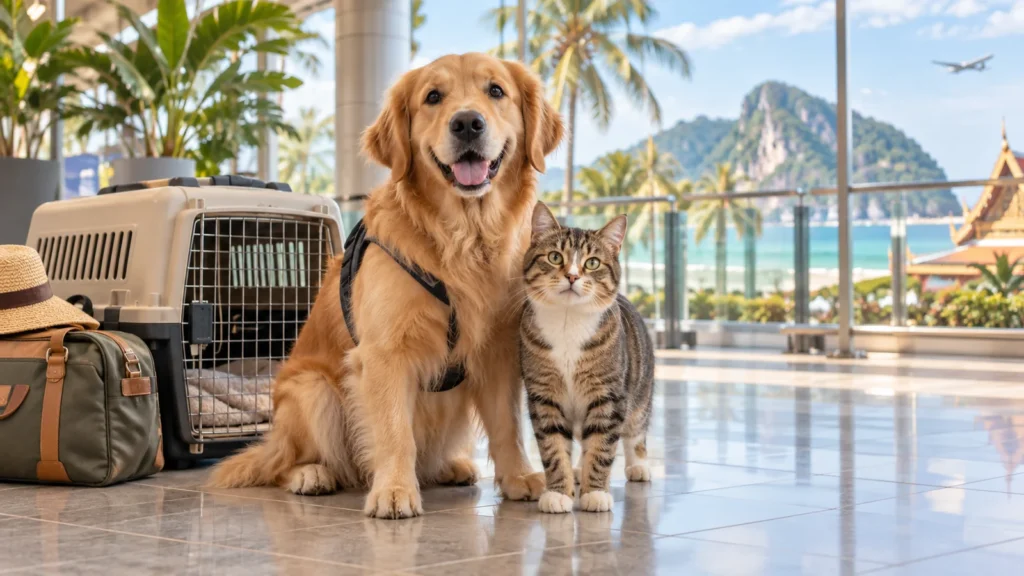
Moving to Thailand with a dog or cat is entirely manageable, but it is a process you should plan before booking the animal’s journey. Thailand regulates live-animal imports through the Department of Livestock Development (DLD), and the paperwork must match the animal, flight and port of entry.
This guide explains the practical process for bringing a pet to Thailand, from vaccinations and the import application to arrival, airline planning and finding pet-friendly accommodation in Hua Hin. Requirements can change according to animal type, country of origin and disease situation, so always confirm the final requirements with the DLD and your airline before departure.
Part of the Daily Life & Practicalities pillar of the Hua Hin Survival Guide.
Quick checklist: bringing a dog or cat to Thailand
- Identify your Thai port of entry and the responsible Animal Quarantine Station.
- Check the DLD’s current import conditions for your animal and country of origin.
- Make sure vaccinations and identification meet the applicable requirements.
- Apply for permission to import the animal in advance. Current DLD guidance says the R.1/1 application should be submitted at least seven working days before import.
- Arrange the official veterinary health certificate required for travel and Thai entry.
- Confirm the airline’s pet policy, crate rules, breed restrictions and booking procedure separately.
- Carry original documents and copies when the animal arrives.
- Confirm that your Hua Hin house, villa or condominium accepts pets before signing a lease.
Who controls pet imports into Thailand?
The key Thai authority is the Department of Livestock Development (DLD), under the Ministry of Agriculture and Cooperatives. Animal Quarantine Station officials at the port of entry inspect the documentation and animal and handle the import licensing process.
Thailand’s current DLD procedure requires an advance application for importing animals. The department states that the application is made using Form R.1/1 through its animal-movement process and should be filed at least seven working days before import. DLD officials then review the documents and relevant animal-disease situation and issue the applicable import conditions.
Step 1: start with your pet’s identification and vaccination record
Do not treat the vaccination booklet as an afterthought. Your pet’s identifying details should be consistent across the veterinary record, health certificate, transport booking and import documents. Where a microchip is used, make sure the number can be read and is copied accurately onto every relevant document.
Rabies vaccination is particularly important for international pet travel. Other vaccination requirements may apply depending on whether you are importing a dog, cat or another animal. The exact health conditions supplied or confirmed by the DLD for your import should take priority over generic internet checklists.
Step 2: contact the Thai Animal Quarantine Station before travel
Your arrival airport or other port of entry matters because the relevant Animal Quarantine Station handles the import. Contact the station sufficiently early, explain the species, origin country, planned arrival date and flight, and ask for the current requirements.
This is also the safest way to resolve questions about unusual circumstances such as multiple animals, pets arriving as manifest cargo, transit through another country, or an animal other than a dog or cat.
Step 3: apply for the import permission
DLD’s published procedure says an importer should submit the R.1/1 application at least seven working days before import. Supporting material can include identification or passport documentation, animal identification details and, where available or applicable, the veterinary health certificate and transport documentation.
Do not leave this until the day before the flight. A sensible relocation plan gives you additional time in case the authorities or airline request a correction or extra document.
Step 4: obtain the official health certificate
The animal needs the veterinary documentation required by Thailand. DLD guidance states that the health certificate presented for import must be issued by the competent government veterinary authority in the country of origin and comply with the health requirements set for the import.
The exact process differs by country. In some countries a private veterinarian prepares the examination and paperwork before a government veterinary authority endorses or certifies it. Ask your local official veterinary authority what procedure applies where you live.
Step 5: check the airline rules separately
Thai government permission and airline acceptance are two different things. Having the correct Thai documents does not automatically mean an airline will carry your pet.
Before paying for a non-refundable itinerary, check whether the airline accepts the animal in the cabin, as checked baggage or only as manifest cargo; maximum carrier dimensions and weight; approved crate specifications; seasonal or temperature restrictions; transit-country rules; and restrictions applying to particular breeds, especially snub-nosed dogs and cats.
Pet capacity can also be limited on individual flights, so reserve the animal’s place rather than assuming it can simply be added at check-in.
Step 6: prepare for arrival in Thailand
Shortly before arrival, reconfirm the flight details with the relevant Animal Quarantine Station if instructed to do so. DLD procedures require the importer to provide arrival and transport information and to present the original official health documentation for inspection.
Keep the originals together in your hand luggage, not inside checked baggage. It is also sensible to carry digital scans and paper copies.
What happens at the airport?
The precise sequence can vary by airport and shipment type, but expect the animal and documents to be checked by the Animal Quarantine Station and for the Thai import licensing/customs formalities to be completed before the pet is released.
If paperwork is incomplete, inconsistent or the animal does not meet the applicable health conditions, entry can become considerably more complicated. That is why confirmation before departure is more important than relying on somebody else’s old checklist.
Does Thailand quarantine dogs and cats?
Do not assume that every normally documented pet will automatically spend weeks in quarantine. The practical focus for routine pet imports is compliance with DLD health and import requirements and inspection on arrival. However, quarantine or other veterinary control measures can be imposed when officials consider them necessary, including where there are health concerns or documentation problems.
For that reason, it is better to describe Thailand as a country with an animal-import inspection and quarantine system rather than promising that a pet can never be quarantined.
How far in advance should you start?
Although the DLD application has a minimum advance filing period, the entire relocation should be started much earlier. For a straightforward dog or cat move, beginning four to eight weeks before travel gives useful breathing room for vaccinations, veterinary appointments, official certification, airline approval and document corrections. Start earlier if your pet needs new vaccinations or if your origin country has a lengthy government-endorsement procedure.
Bringing more than one pet
If you are relocating with several animals, contact the DLD station and airline before making assumptions about how a normal single-pet procedure applies. Airlines may limit the number of animals per passenger or flight, and larger movements can be treated differently operationally.
Other animals: birds, rabbits and exotic pets
This guide is primarily for dogs and cats. Birds, rabbits, reptiles and exotic species can be subject to different veterinary controls, temporary disease-related restrictions, wildlife rules or additional permits. Thailand periodically restricts imports of particular animal categories from affected countries in response to disease outbreaks. Confirm the current position directly with the DLD before arranging transport.
Transit countries can create extra requirements
A journey that changes aircraft or leaves the international transit area in another country may trigger that country’s animal transit or import rules. When comparing flights, a direct routing can therefore be simpler even when the ticket itself costs more.
Moving from Bangkok to Hua Hin with your pet
Many international pets arrive through Bangkok and then continue by road to Hua Hin. Plan this final leg before you fly. Confirm that your taxi, private transfer or rental arrangement accepts animals and that the vehicle has enough room for the travel crate.
For a long drive after an international flight, have water available and avoid unnecessary heat exposure. Never leave an animal unattended in a parked vehicle in Thailand’s climate.
Finding pet-friendly accommodation in Hua Hin
The import paperwork is only half of the relocation. Many Hua Hin condominiums restrict pets or prohibit them completely under the building’s rules. A landlord saying “pets are OK” does not necessarily override condominium regulations.
Before paying a deposit, obtain written confirmation of the pet policy and disclose the type, size and number of animals. Houses and villas often provide more flexibility, particularly for larger dogs, but individual landlords can still impose restrictions.
For the wider housing decision, see our Condo vs Villa vs Pool Villa guide and the Hua Hin property section.
Life with a pet in Hua Hin
Once settled, think about the practical realities of Thailand’s climate. Walk dogs during cooler morning and evening periods, provide constant access to shade and water, and discuss local parasite prevention with a veterinarian. Tropical conditions can mean that tick, flea, heartworm and other preventive care differs from what you were used to at home.
When choosing a home, also consider secure fencing, nearby walking areas, traffic, soi dogs and how easily you can reach a veterinary clinic in an emergency.
Common mistakes to avoid
- Using an old online checklist: animal-health rules can change.
- Booking the flight before checking pet space: passenger availability does not guarantee animal capacity.
- Assuming airline approval equals Thai import approval: they are separate processes.
- Putting original paperwork in checked luggage: keep it accessible.
- Ignoring transit rules: the country between home and Thailand may have its own requirements.
- Signing a condo lease without checking building rules: confirm pet permission in writing.
- Leaving everything until the minimum filing deadline: allow time to fix paperwork.
Frequently asked questions
Do I need an import permit to bring my dog or cat to Thailand?
Thailand regulates the import of live animals through the DLD. Its current published procedure calls for an advance R.1/1 application and subsequent import licensing formalities. Confirm the exact documents with the Animal Quarantine Station responsible for your port of entry.
How early should I apply?
DLD guidance says the application should be submitted at least seven working days before import. For the overall relocation, starting several weeks earlier is much safer.
Can my pet fly in the cabin?
That depends on the airline, route, pet size and aircraft. Thailand’s import requirements do not determine whether an airline permits cabin travel.
Will my pet be quarantined?
Routine compliant arrivals are handled through veterinary import controls and inspection, but officials retain the ability to impose quarantine or other measures when required. Never rely on an unconditional “no quarantine” promise.
Can I bring a pet into a Hua Hin condominium?
Only if the building rules allow it. Check with the juristic office or management and obtain written confirmation before signing the lease.
Are the rules the same for birds and exotic animals?
No. Different species can face additional veterinary, disease-control or wildlife requirements. Ask the DLD about your exact species before arranging travel.
Official information and final checks
Because animal import conditions can change, verify the current requirements with Thailand’s Department of Livestock Development and the Animal Quarantine Station at your intended port of entry. Also reconfirm the airline’s rules shortly before departure.
Last reviewed: September 2026. This guide is intended as practical relocation information, not a substitute for an import permit, veterinary certificate or instructions issued by Thai authorities.
Continue planning your move to Hua Hin
Ask Next Step Hua Hin
Type your question below to search our website and receive an immediate answer.


