
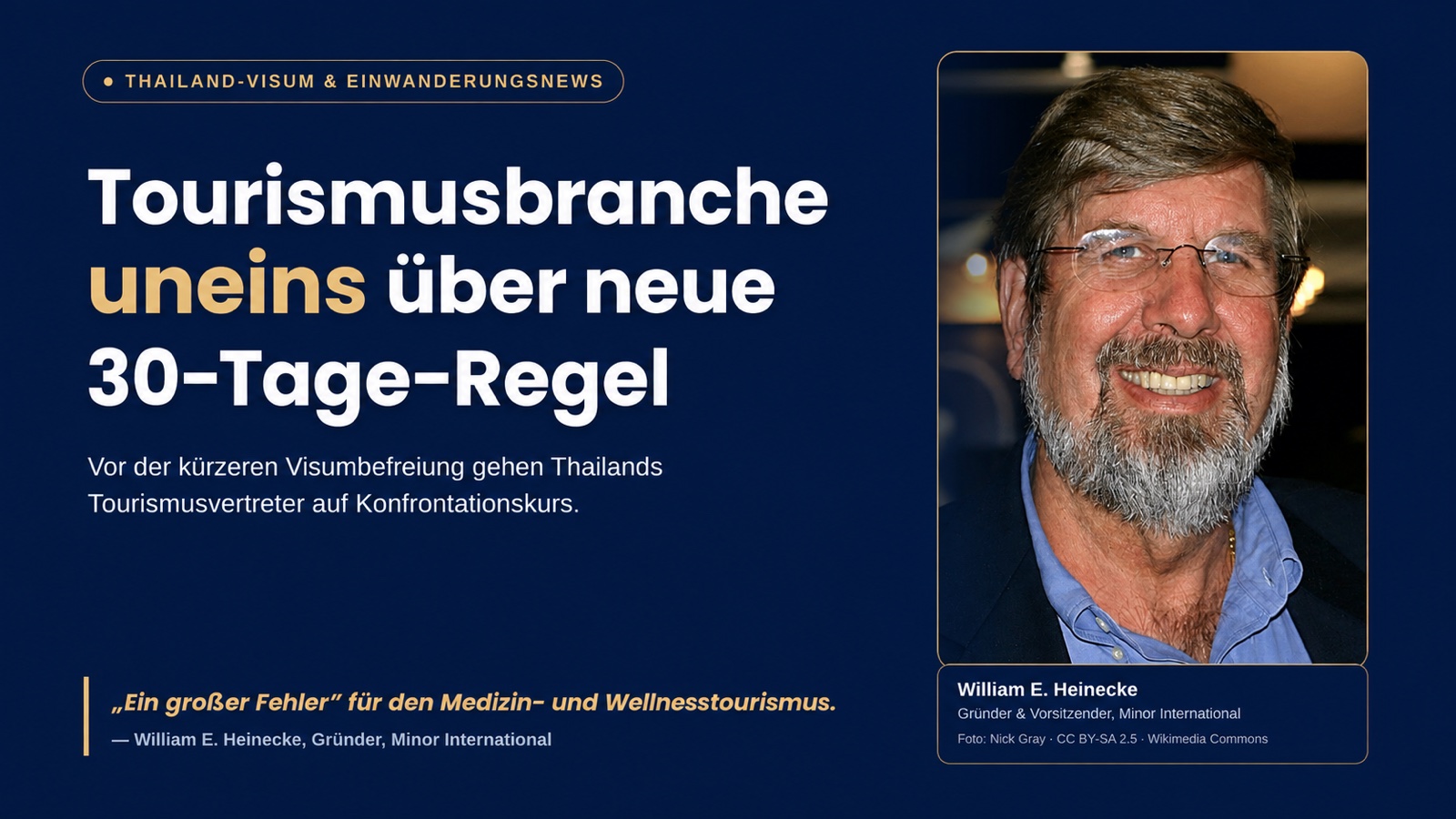
Thailand’s tourism industry is split over the incoming 30-day visa exemption, with hospitality and wellness-tourism leaders warning it could hurt high-value visitors while other operators say a shorter stay is overdue.
Industry reaction, not a rule change
As the 15 September start date approaches, Thai tourism figures have taken increasingly public and conflicting positions on the shortened stay, according to a report by Thai Examiner. The debate does not affect the confirmed start date or the country list—see our full explainer on Thailand’s 30-day visa exemption rules for the official details. It does, however, signal where enforcement pressure and possible future adjustments may come from.
The case for a shorter stay
Sisadiwat Cheewaratanaporn, honorary president and advisory board chair of the Association of Thai Travel Agents (ATTA), argues the change matches how most visitors actually travel. He points out that the typical tourist stays only around 7 to 10 days, so a 30-day allowance is more than enough for genuine holidaymakers. His concern is less about tourism numbers and more about misuse: he says some travellers have used the longer 60-day exemption to work informally or run small businesses that compete unfairly with Thai entrepreneurs. He has also pressed the government to address Thailand’s reputation for safety—citing road accidents, fires and high-profile crime cases—and to respond to growing competition from Vietnam and Malaysia for the same travellers.
The case against: medical and wellness tourism at risk
The most prominent opposing voice is William E. Heinecke, founder and chairman of Minor International. He has called the shorter exemption “a big mistake,” warning that it does not fit how medical and wellness tourists actually plan their trips. Treatment and recovery for many procedures routinely run past 30 days, and Heinecke argues that a blanket length-of-stay cut risks turning away exactly the higher-spending, longer-staying visitors Thailand says it wants to attract. His preferred fix is tighter screening at entry and during a stay, rather than a shorter allowance for everyone.
Regional tourism areas flag their own exposure
Away from Bangkok and the beach resorts, some regional tourism bodies say long-stay visitors are a meaningful share of their market. La-iad Bungsrithong, adviser to the Thai Hotels Association’s Northern Region chapter, estimates long-stay travellers make up roughly 5 to 8 percent of arrivals in Chiang Mai and is seeking alternative arrangements for that segment. In Mae Hong Son province, Panudej Chaiyasakul, president of the local tourism business association, puts the figure at closer to 15 percent of visitors to Pai—a much larger share of a smaller, longer-stay-dependent market.
What this means for travellers right now
None of this changes what takes effect on 15 September: eligible nationals will receive 30 days visa-free, down from 60. Anyone planning a trip built around a longer stay—particularly for medical treatment, wellness retreats or extended remote work—should not wait for the debate to resolve itself. Check whether a longer-stay visa category fits the trip better than the exemption, and confirm the entry stamp actually issued on arrival rather than assuming the old allowance still applies. Our guides to Thailand’s proof-of-funds expectations and the Thailand Digital Arrival Card cover the practical steps for any arrival after 15 September.
Considering a longer stay in Thailand?
If a 30-day exemption will not cover your plans—medical treatment, wellness recovery or an extended stay in Hua Hin—Next Step Hua Hin can review your options and recommend a visa category that actually fits. Contact our team for a free consultation before you book.
This article reports on tourism-industry reaction as published by Thai Examiner on 6 September 2026. It does not change the confirmed 30-day visa exemption rule, which Next Step Hua Hin checked separately against the Thai Government announcement of 14 July 2026.
Choose Next Step Hua Hin as a preferred source
Increase the chance of seeing our Visa News in Google Top Stories.
 Als bevorzugte Quelle hinzufügen
Fragen Sie Next Step Hua Hin
Geben Sie unten Ihre Frage ein, um unsere Website zu durchsuchen und sofort eine Antwort zu erhalten.


