
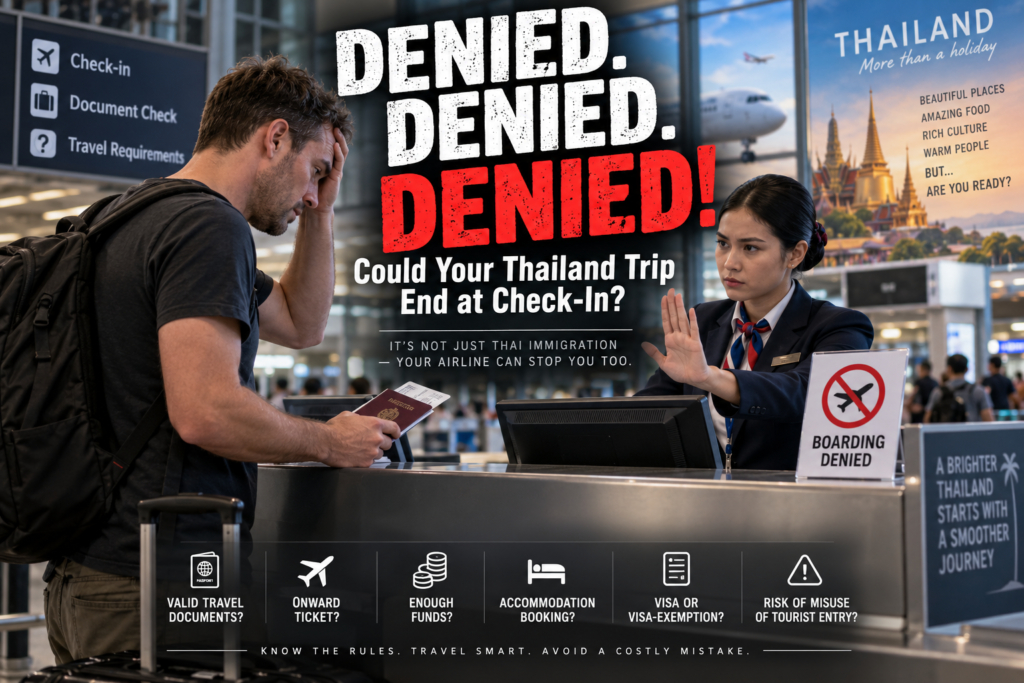
You have your passport. Your bags are packed. Your hotel in Thailand is booked. You arrive at the airport, walk up to the airline check-in counter and hand over your passport.
Then comes the question:
“Can I see your ticket out of Thailand?”
You do not have one.
You explain that you plan to decide later. Perhaps you intend to extend your stay, travel overland to another country, or simply buy another ticket once you know your plans.
The check-in agent looks at the screen, calls a supervisor and gives you the answer you were not expecting:
You cannot board the flight.
Your Thailand holiday may be over before it has even started.
Many travelers assume that only Thai Immigration can decide whether they are allowed to enter Thailand. That is not quite the whole story.
Your airline can refuse to carry you to Thailand if it believes you do not meet Thailand's entry requirements or there is a significant risk that Thai Immigration will refuse you entry.
This distinction is important:
- The airline can deny you boarding before departure.
- Thai Immigration can deny you entry after you arrive in Thailand.
They are separate decisions, made by different parties, but they are closely connected.
Why Would an Airline Care Whether Thailand Lets You In?
Because transporting an inadmissible passenger can become the airline's problem.
Airlines check passengers' travel documents against destination and transit requirements before allowing them to board. If a passenger is transported to Thailand and Thai authorities subsequently refuse that passenger entry, the carrier can have obligations concerning the passenger's removal.
That gives airlines a very practical reason to check your documentation before you leave your departure airport.
The airline employee is not acting as a Thai immigration officer and cannot grant or refuse you immigration permission to enter Thailand.
But the airline can decide not to transport you.
That means you effectively have two checkpoints to pass:
Checkpoint 1: Your airline at departure
Checkpoint 2: Thai Immigration on arrival
Passing the first does not guarantee that you will pass the second.
The Onward-Ticket Problem
This is probably one of the most common areas of confusion.
A traveler may be legally eligible to travel to Thailand without obtaining a visa in advance, but that does not necessarily mean the traveler should arrive at check-in with nothing except a passport and a one-way ticket.
Depending on your nationality, visa or visa-exemption status and intended length of stay, you may be expected to demonstrate that you intend to leave Thailand within your permitted period.
An airline may therefore ask for evidence such as:
- A confirmed flight leaving Thailand
- A ticket to another country
- Evidence that the onward journey falls within the permitted period
- Appropriate documentation for your next destination
Simply saying:
“I'll buy a ticket later”
may not satisfy the airline.
Nor should you assume that saying you plan to extend your stay after arrival will solve the problem. An extension that you hope to obtain in Thailand is not necessarily the same thing as having evidence, at check-in, that your journey complies with the conditions applicable to your entry.
If you are traveling on a one-way ticket, this is something you should investigate before going to the airport.
Airline Denial vs Thai Immigration Denial: What Can Go Wrong?
The following table illustrates some of the situations travelers may encounter. The exact requirements depend on nationality, passport, visa status, travel history and individual circumstances.
| Scenario | Airline may deny boarding? | Thai Immigration may deny entry? | Why it can become a problem |
|---|---|---|---|
| No valid passport | Yes | Yes | You do not have acceptable travel documentation |
| Passport validity/document issue | Yes | Yes | Passport may not satisfy applicable entry requirements |
| Visa required but traveler has no visa | Yes | Yes | Traveler does not have the required permission/documentation |
| No onward/return ticket when one is required or requested | Yes | Yes | Concern that traveler cannot demonstrate an intention to leave within the permitted stay |
| Onward flight is after permitted stay | Yes | Yes | Your itinerary may not match your authorized period |
| Cannot demonstrate adequate funds when required | Possible | Yes | Financial means can form part of immigration assessment |
| Cannot explain where you are staying | Possible | Yes | Immigration may question the genuine purpose and arrangements for the visit |
| No accommodation information | Possible | Yes | May trigger additional questioning |
| Frequent back-to-back tourist/visa-exempt entries | Possible | Yes | Immigration may examine whether the traveler is genuinely visiting as a tourist |
| Long history of stays in Thailand using tourist-type entries | Possible | Yes | Entry is not guaranteed merely because a traveler previously entered successfully |
| Previous overstay | Possible | Yes | Immigration history may lead to closer scrutiny and may have legal consequences |
| Existing Thai blacklist/re-entry prohibition | Yes if identified | Yes | Passenger may not be admissible |
| Suspicion traveler intends to work without appropriate authorization | Possible | Yes | Intended activities may be inconsistent with claimed tourist status |
| False or altered documents | Yes | Yes | Potentially very serious immigration and legal consequences |
| Cannot satisfy transit-country requirements | Yes | N/A | You may never reach Thailand because the airline must also consider transit requirements |
| Valid visa but circumstances raise admissibility concerns | Possible | Yes | A visa does not necessarily create an absolute right of entry |
| Valid return ticket, hotel and funds | Usually far lower risk | Still possible | Final admission remains with Thai Immigration |
Important: “Possible” does not mean airlines routinely demand every item from every passenger. Checks can vary considerably according to route, nationality, visa status, documentation and circumstances.
“But I Have a Thai Visa”
A visa is extremely important, but travelers should avoid treating it as an unconditional guarantee of admission.
There is an important difference between:
being issued a visa
and
being admitted at the Thai border.
The final immigration inspection takes place when you arrive.
An immigration officer can examine your passport, visa, previous entries, travel history, reason for visiting, intended accommodation and other relevant circumstances.
If the officer is not satisfied that you meet the applicable conditions for entry, having a visa does not necessarily prevent further questioning or refusal.
“But I've Entered Thailand Like This Before”
This is another dangerous assumption.
A traveler might say:
“I've flown to Thailand five times with a one-way ticket and nobody ever asked.”
That may be completely true.
It does not mean the sixth airline must allow the passenger to board or that Thai Immigration must admit the traveler again.
Different airlines may conduct checks differently. Different routes can produce different checks. Documentation can be examined more closely on one journey than another.
Most importantly, your previous successful entry does not guarantee your next one.
What Happens If Your Airline Denies Boarding?
If the problem occurs at your departure airport, you are still outside Thailand.
Depending on the reason, you may be able to resolve the issue.
For example, if the airline's concern is simply the absence of acceptable onward travel, it may sometimes be possible to purchase an appropriate ticket and present it to the airline.
But do not rely on being able to fix everything at the check-in counter.
There may not be enough time.
The airline may close check-in.
An appropriate flight may be expensive.
The issue may involve your visa or passport rather than your onward journey.
The supervisor may need additional verification.
Sort out your Thailand entry documentation before leaving home, not while the departure board is counting down to your flight.
What Happens If You Reach Thailand and Immigration Refuses Entry?
This is considerably more serious.
If Thai Immigration refuses you permission to enter, you do not simply collect your suitcase and walk into Bangkok.
You have not been admitted into Thailand.
You may be kept in a restricted immigration holding or detention area at the airport while arrangements are made concerning your departure. Depending on the airport and circumstances, this can involve being held in a secure room or detention facility rather than being free to enter Thailand or leave the airport as you wish.
At Bangkok's major international airports, this can be an extremely unpleasant experience.
You may have to remain there until arrangements are made for you to leave Thailand, potentially on a return or onward flight as directed by the authorities.
This is precisely one reason airlines take documentation checks seriously before departure.
They do not want to transport a passenger thousands of kilometres only to have that passenger rejected at the Thai border and require removal arrangements.
Will You Literally Be Put in a Cell?
Travelers sometimes describe airport immigration detention as being “put in a cell.”
That can give the wrong impression if taken too literally.
The important point is this:
If you are formally refused entry, you should not expect to remain a normal transit passenger sitting freely in the departure lounge.
You can be held under immigration control in a secure holding/detention area pending removal.
The exact facility and procedure can differ depending on the airport, circumstances and how long you have to wait.
This can happen at an international airport in Thailand, not only at Bangkok Suvarnabhumi.
Having Money in Your Bank Is Not Always the Same as Being Able to Prove It
Another misunderstood area is proof of funds.
Travelers occasionally assume:
“I have plenty of money. Immigration can just look at my banking app.”
That is not a safe assumption.
If evidence of financial means is required in your circumstances, you should understand what form of evidence is acceptable rather than deciding yourself what an officer ought to accept.
The same principle applies to accommodation.
Knowing the name of your hotel is better than knowing nothing, but having your booking details, address and contact information readily available makes answering questions much easier.
Frequent Entries Can Attract More Questions
Thailand is enormously popular with people who spend substantial periods of the year in the country.
However, tourist and visa-exempt entry should not be viewed as an automatic substitute for obtaining an immigration status appropriate for someone's real circumstances.
Someone arriving for a two-week holiday after spending the previous year in Europe presents a very different travel pattern from someone who has spent most of the year in Thailand through repeated short-term entries.
That does not automatically mean the second traveler will be refused.
It does mean that immigration officers may have more questions.
They may want to understand:
- Why are you coming to Thailand?
- How long will you stay?
- Where will you live?
- When are you leaving?
- How are you supporting yourself?
- Are you working?
- Why have you made so many previous entries?
- Is the immigration category you are using appropriate for what you are actually doing?
Answer truthfully.
Trying to invent an explanation at the immigration desk is a very poor strategy.
Never Use Fake Onward Tickets or Altered Documents
There is an enormous difference between buying a genuine inexpensive onward ticket and presenting false documentation.
Do not alter flight confirmations, manufacture hotel reservations, edit bank statements or use fabricated travel documents to satisfy an airline or immigration officer.
What began as a relatively simple documentation problem can become much more serious when false information or fraudulent documents are involved.
If your itinerary does not comply with the requirements, fix the itinerary rather than falsifying the evidence.
Before Flying to Thailand: The Safer Checklist
Before leaving for the airport, check:
- Passport – Is it valid and does it meet the applicable requirements?
- Visa – Do you need one, and if so, do you have the correct one?
- Visa exemption eligibility – Is your nationality currently eligible and for how long?
- Onward travel – Can you demonstrate how and when you intend to leave Thailand if required?
- Length of stay – Does your itinerary fit the period you expect to receive?
- Accommodation – Have the name, address and booking/contact details available.
- Financial means – Understand any applicable requirement and be prepared to demonstrate it in an acceptable form.
- Travel history – If you have spent extensive periods in Thailand, be prepared for questions.
- Purpose of travel – Make sure your visa/entry category matches what you genuinely intend to do.
- Transit requirements – Check the rules of any country through which you transit.
- Airline requirements – Check with your airline before departure if your circumstances are unusual.
- Current Thai entry rules – Immigration rules change. Verify them shortly before traveling.
Three Travelers, Three Very Different Outcomes
Traveler A: The straightforward holiday
Anna is coming to Thailand for three weeks.
She has a valid passport, confirmed hotel reservations, a return flight within her permitted period and sufficient funds for her holiday.
Her itinerary makes sense.
Her risk of documentation-related problems is comparatively low.
Traveler B: The one-way-ticket traveler
David is eligible for visa-exempt travel and has bought a one-way ticket to Bangkok.
He intends to “work out the rest later.”
At check-in, the airline asks him to demonstrate onward travel.
David argues that Thai Immigration has never asked him before.
That argument does not necessarily help him.
The immediate question is not whether he was admitted last year.
It is whether the airline is prepared to transport him today based on the documentation and requirements applicable to his journey.
Traveler C: The frequent visitor
Peter has spent much of the year in Thailand using a series of tourist-type entries.
He has an onward ticket and accommodation, but on arrival an immigration officer notices his extensive travel history and asks additional questions.
Peter may still be admitted.
But his airline allowing him to board did not guarantee his admission.
The airline's decision and Thai Immigration's decision are two different decisions.
The Most Important Rule: Boarding the Plane Does Not Guarantee Entry
There are three concepts travelers should keep separate:
A visa or visa-exemption eligibility allows you to present yourself for travel and immigration inspection under the applicable rules.
An airline decides whether it is willing and permitted to carry you based on the travel documentation and destination/transit requirements it must check.
Thai Immigration makes the final decision on admission at the border.
That is why someone can encounter trouble before ever reaching Thailand — or fly all the way to Bangkok and still fail to enter the country.
Frequently Asked Questions
Can an airline really refuse to let me fly to Thailand?
Yes. Airlines can refuse carriage when required travel documentation or destination/transit requirements are not satisfied, and they may conduct document checks before boarding.
Is an onward ticket always checked?
No. Many travelers are never asked to show one. But “I wasn't asked last time” is not evidence that you will not be asked this time.
Can I just buy an onward ticket at the airport?
Sometimes a documentation problem can be resolved this way, but you should not rely on it. There may be other issues, and you could miss your flight while trying to resolve them.
Does having a visa guarantee entry into Thailand?
No. The final admission decision is made at immigration control.
Can Thai Immigration ask me to show money?
Depending on the applicable immigration category and circumstances, proof of adequate means may form part of the entry requirements or immigration assessment.
What happens if Thailand refuses me entry?
You remain under immigration control and may be held in a secure airport immigration facility while arrangements are made for you to depart Thailand.
Can this happen only at Bangkok Suvarnabhumi Airport?
No. Entry controls apply at Thailand's international ports of entry. Procedures and facilities vary by location.
Should I be worried?
Most properly documented genuine visitors enter Thailand without difficulty.
The lesson is not to panic.
The lesson is to prepare.
A few minutes spent checking your passport, visa status, onward travel and supporting documentation before departure can prevent an extremely expensive and stressful problem at the airport.
Flying to Thailand? Check Before You Travel
Thailand remains one of the world's most welcoming and popular destinations, and the overwhelming majority of visitors have no problem entering the country.
But “visa-free” does not mean “no rules.”
And there is one fact every traveler should remember:
Thai Immigration is not the first authority you need to get past.
Your trip can end at the airline check-in desk before your aircraft ever leaves the ground.
If you are unsure about the appropriate visa or immigration arrangements for your stay in Thailand, Next Step Hua Hin can help you understand your options before you travel.
Consultations are completely free. Give us a call and speak to our team before a visa or immigration problem becomes an airport problem.
Immigration and airline requirements can change and individual cases differ. This guide provides general information and should not be treated as a guarantee of boarding or admission to Thailand.
Ask Next Step Hua Hin
Type your question below to search our website and receive an immediate answer.