
The short answer
Yes, jellyfish can be found in the sea around Hua Hin, Cha-am and the nearby Pranburi coast. Most encounters cause temporary pain, itching or a rash rather than a life-threatening emergency. But you cannot safely identify a jellyfish by assuming that every washed-up animal is harmless, and some toxic species occur in Thai coastal waters.
The practical rule is simple: do not touch a jellyfish, alive or dead; follow beach signs and lifeguard instructions; and leave the water when strong winds, rough seas, recent rain or a visible concentration of jellyfish brings them close to shore.
If a swimmer has severe pain, breathing difficulty, collapse, chest symptoms or rapidly spreading marks after contact, treat it as an emergency. Get the person out of the water, call Thailand’s medical emergency number 1669, and follow the first-aid steps below.
Emergency first aid for suspected toxic jellyfish exposure: get out of the water, keep the person still, do not rub the skin, call 1669, and pour ordinary household vinegar (about 4–6% acetic acid) continuously over the affected area for at least 30 seconds. Do not use fresh water, alcohol, urine, ice or fizzy drinks. If the person is not breathing normally or has no pulse, start CPR immediately.
This is general safety information, not a diagnosis. A medical professional should assess anyone with severe, persistent or worsening symptoms.
Are jellyfish common in Hua Hin?
They are a recurring coastal hazard rather than a constant reason to avoid the beach. Numbers can change quickly with wind, waves, currents, rainfall and food availability. The most useful local warning is not a calendar date but what is happening on the beach that day: recent rain, monsoon weather, rough water, stranded jellyfish or a posted warning should all make swimmers more cautious.
Thai public-health guidance says toxic jellyfish may be found close to shore, especially after rain and during the rainy season on the Gulf coast. That does not mean every rainy-season swim is dangerous, or that Hua Hin has a fixed “jellyfish season” with the same intensity every year. It means conditions can bring jellyfish into shallow water when people are swimming.
The main local pattern is seasonal and weather-driven. Cha-am fisheries officials described the October 2025 mass stranding at Bo Yai Beach as an annual phenomenon associated with strong monsoon winds and waves. The animals were identified as Catostylus mosaicus, commonly called jelly blubber, which officials described as mildly venomous and generally not life-threatening, while still advising people not to touch them. The report is useful because it shows how large numbers of comparatively low-risk jellyfish can arrive on the beach without proving that dangerous box jellyfish are present.
What has actually been documented locally?
It is important to separate confirmed local reporting from general Thai risk information.
In August 2017, eight foreign tourists were treated at Pranburi Hospital after jellyfish stings along the coast between Pak Nam Pran and Khao Kalok, around 15 kilometres south of Hua Hin. Reports described many Chrysaora jellyfish in the water and on the beach after rough seas. The incident shows that painful mass-stinging events can affect this coastline, especially during unsettled weather. It does not establish that the animals were box jellyfish, nor that the same conditions occur every year.
In October 2025, thousands of jellyfish washed ashore along more than a kilometre of Cha-am coastline. Local fisheries officials identified the animals as jelly blubber and linked the stranding to strong southwesterly monsoon winds and waves. That is a documented Cha-am event, but it should not be used to identify every jellyfish found around Hua Hin.
Thailand’s national public-health data also matters. The Department of Disease Control reported 48 serious injuries or deaths associated with box jellyfish from 1999 to 2021. Most of the best-known fatal box-jellyfish incidents have been reported elsewhere in Thailand, particularly around islands and other coastal areas. We have not found reliable evidence that box jellyfish are common at Hua Hin Beach itself. The responsible wording is therefore: toxic jellyfish are a real national risk, while the local Hua Hin–Cha-am evidence more often documents seasonal strandings and painful stings than a persistent local box-jellyfish population.
Which jellyfish might you see?
Visitors should avoid trying to identify a jellyfish by colour alone. Light, water conditions and decomposition can change its appearance, and a photograph taken from a safe distance is more useful than handling the animal.
Local and regional reports mention several broad groups:
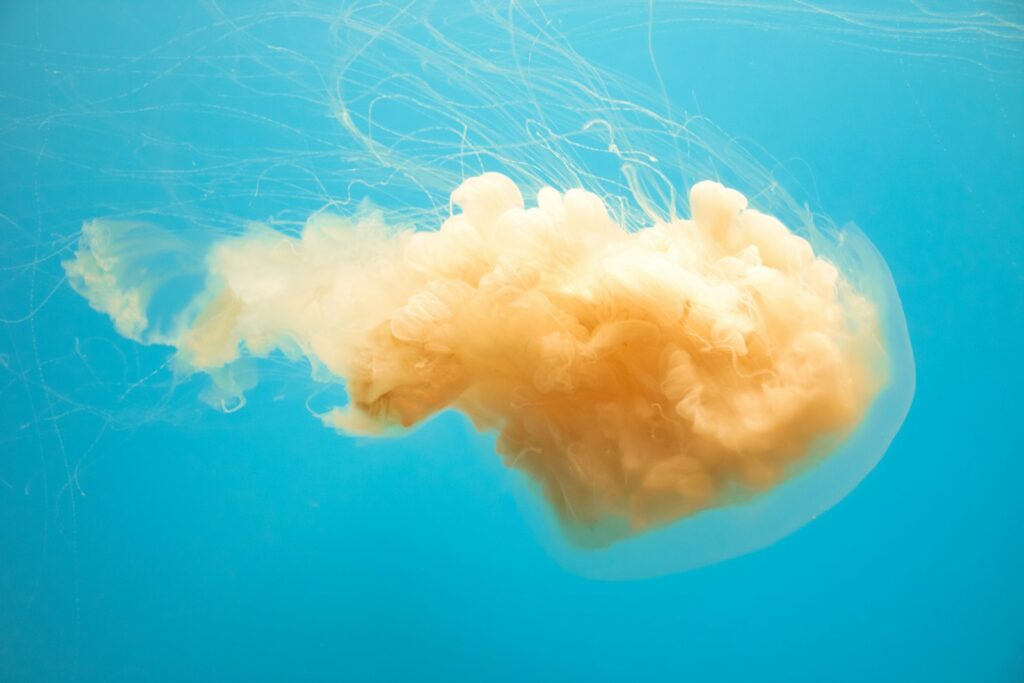
- Jelly blubber (Catostylus mosaicus): dome-shaped jellyfish that can strand in large numbers. Local officials described the 2025 Cha-am event as usually causing mild irritation, but advised against contact.
- Chrysaora or “fire” jellyfish: reported during the 2017 Pranburi incident. Stings can be very painful and may produce a marked skin reaction.
- Box jellyfish: a group that includes species capable of severe envenomation. Thai authorities describe transparent, box-shaped animals with tentacles extending from the corners; identification should not be left to an untrained swimmer.
- Bluebottle or Portuguese man-of-war (Physalia): technically a siphonophore rather than a true jellyfish, but commonly included in beach warnings. Its tentacles can sting even when the float is no longer obvious.
The safety message is the same for all of them: do not touch, collect or step on stranded animals. Tentacles and stinging cells may remain active after the animal has died.
What should you do before swimming?
Check the beach before getting in, especially after rain or a storm. Look for warning flags, temporary signs, vinegar stations, jellyfish nets and advice from lifeguards or local staff. If there are many jellyfish on the sand, do not assume the water is clear.
Choose a supervised swimming area and stay within marked zones. Children should remain within arm’s reach when the water is unsettled or visibility is poor. A long-sleeved rash vest and swim leggings reduce exposed skin, although no clothing guarantees protection.
Do not swim outside a net or marked safe area just because other people are doing so. Do not swim alone, and do not enter the water when a beach warning is active. If you see jellyfish while swimming, calmly leave the water and tell the lifeguard or beach operator rather than trying to push them away.
First aid after a jellyfish sting in Thailand
The first priority is safety and rapid escalation, not trying to identify the animal.
- Get out of the water. Prevent a second injury or drowning.
- Call for help and dial 1669 if symptoms are severe, the person is a child, the sting is extensive, or you suspect a toxic jellyfish.
- Keep the person still. Movement and rubbing can trigger additional venom discharge from stinging cells.
- Do not rub, scrape or massage the skin. Do not pick up tentacles with bare hands.
- For suspected toxic jellyfish exposure, pour household vinegar continuously over the affected area for at least 30 seconds. Thai Department of Disease Control guidance specifies ordinary vinegar of roughly 4–6% acetic acid.
- Do not pour fresh water, drinking water, alcohol, urine, ice or carbonated drinks over the sting. Thai public-health warnings say these can worsen venom discharge or are not appropriate first aid.
- If the person is unconscious, not breathing normally or has no pulse, begin CPR immediately and follow the emergency operator’s instructions. Do not delay life-saving resuscitation to look for vinegar.
- Seek medical assessment. Even when the initial pain settles, worsening pain, breathing difficulty, vomiting, faintness, chest tightness, widespread rash or unusual weakness needs urgent care.
There is a nuance worth making explicit: first-aid advice can vary for different marine animals and in different countries. This article follows the Thai Department of Disease Control and Department of Marine and Coastal Resources guidance for suspected toxic jellyfish in Thailand. If a lifeguard, emergency clinician or current Thai public-health notice gives a more specific instruction for the incident, follow that instruction.
When should you go to hospital?
Call 1669 or go to emergency care immediately for collapse, breathing problems, chest pain or tightness, severe or rapidly increasing pain, confusion, fainting, persistent vomiting, a rapidly spreading rash, extensive contact, or any sting involving a young child or someone with a serious medical condition.
For a small localised rash with no other symptoms, ask a pharmacist or clinician for advice rather than relying on online treatment suggestions. Do not drive yourself if you feel faint or unwell. Hua Hin has private and public hospitals; the Survival Guide’s Emergency Numbers in Hua Hin page lists the national emergency number and local preparation advice, while Healthcare in Hua Hin explains the local hospital options.
Does this mean Hua Hin beaches are unsafe?
No. It means beach safety in Hua Hin is partly about reading conditions rather than assuming the sea is identical every day. Most people visit the beaches without a serious jellyfish incident. A sensible swimmer checks warnings, avoids visible strandings, uses supervised areas and knows what to do if someone is stung.
The historical ASEAN NOW discussion that prompted this article is still useful as a reminder that residents have noticed jellyfish along the coast for many years. It is not a substitute for current medical guidance, species identification or a same-day beach warning. We have used it as historical background, while relying on Thai public-health and marine-authority material for the first-aid section.
For current weather-related decisions, also see the Hua Hin month-by-month planner and the Hua Hin heavy-rain and flood preparation guide. For families, the Raising a Family in Hua Hin guide is the natural companion resource.
Frequently asked questions
What months are jellyfish most common in Hua Hin?
There is no reliable fixed month-by-month rule for Hua Hin. Sightings and strandings may increase during rainy or monsoon conditions, after rain and when winds and waves push jellyfish towards shore. Check the beach on the day you swim.
Are box jellyfish found in Hua Hin?
Box jellyfish occur in Thai waters, and toxic jellyfish must be taken seriously. We have not found strong evidence that box jellyfish are common at Hua Hin Beach. Do not treat that uncertainty as a reason to handle an animal or ignore a warning.
Should I use vinegar after every jellyfish sting?
Thai authorities recommend household vinegar for suspected toxic-jellyfish exposure, poured continuously for at least 30 seconds, alongside emergency care. Do not rub the skin or use fresh water. If the animal is uncertain or symptoms are severe, call 1669 and follow the emergency operator or clinician’s advice.
Can a dead jellyfish still sting?
Yes. Stranded jellyfish and detached tentacles may still contain active stinging cells. Keep children and dogs away and never handle one with bare hands.
Is Cha-am affected too?
Yes. Cha-am and the wider Gulf coastline can experience the same wind- and wave-driven strandings. The documented October 2025 Cha-am event involved jelly blubber, but the safe response to any unknown jellyfish is still to avoid contact and follow local warnings.
What is Thailand’s emergency number for a jellyfish sting?
Call 1669 for Thailand’s medical emergency service. For public-health questions, the Department of Disease Control lists hotline 1422.
Sources and review note
This guide was prepared using Thai Department of Disease Control first-aid and risk guidance, Department of Marine and Coastal Resources educational material, local reporting from Hua Hin Today, historical local reporting on the 2017 Pranburi incident, and the supplied ASEAN NOW discussion as background. Medical and local conditions can change; the page should be reviewed when Thai authorities issue a new beach-safety notice or when a verified local incident changes the evidence.
Ask Next Step Hua Hin
Type your question below to search our website and receive an immediate answer.