
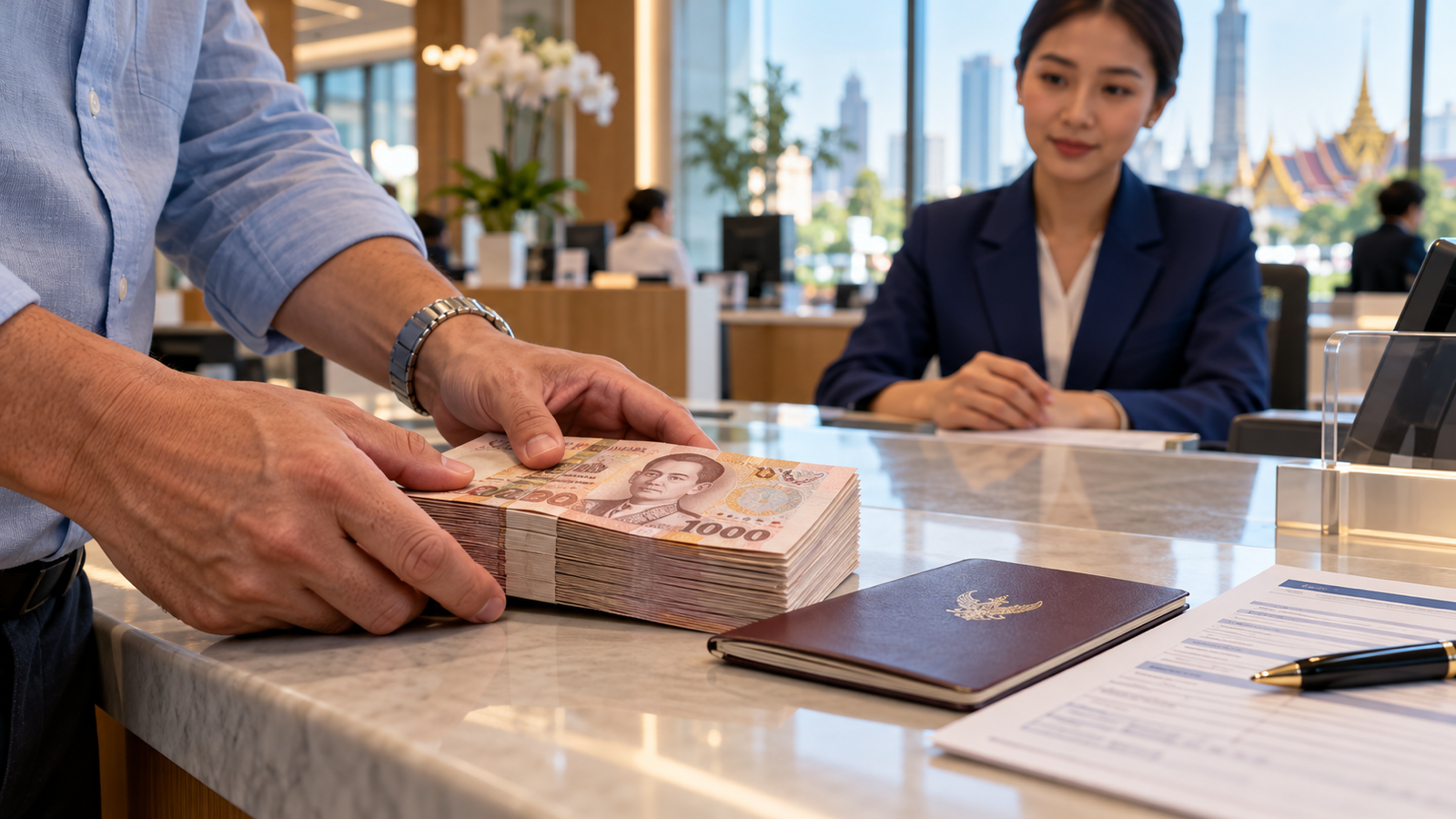
Updated 27 October 2026: Thailand is tightening checks on very large cash transactions at bank branches. From 1 November 2026, people handling cash-related transactions of THB 5 million or more in one day should expect more questions about the money, its purpose and supporting documents.
The measure matters to foreign residents, property buyers, businesses and anyone arranging a large cash payment in Thailand. It is not a blanket ban on cash and it does not mean an account is automatically frozen. The Bank of Thailand (BOT) says the aim is to reduce the use of the financial system for fraud, “grey money” and other illegal activity.
What changes on 1 November?
Under BOT Notification No. 57/2026, financial institutions must apply enhanced due diligence to qualifying cash-related transactions of THB 5 million or more in a single day. The checks are risk-based, so the exact questions and documents can vary between customers and transactions.
A bank may ask for:
- the source of the funds;
- the reason and intended use of the money;
- updated customer and identity information; and
- documents supporting the transaction or source of funds.
The rule covers more than a straightforward cash deposit. BOT guidance also includes certain cheque or draft deposits, exchanging Thai baht banknotes, receiving cash to issue a cheque or draft, buying or selling foreign currency, and cash payments for insurance, investment products or financial derivatives.
Does this affect electronic transfers?
This specific BOT cash-risk measure applies to transactions carried out through bank branches. The central bank says it does not change ordinary use of electronic channels. However, banks still monitor unusual activity and may apply separate customer-profile, anti-fraud or anti-money-laundering checks to any payment method.
In practical terms, a documented bank transfer may be easier to trace than carrying a large amount of banknotes. That does not remove the need to explain a suspicious or unusual transaction, and customers should follow their bank’s instructions rather than splitting payments to avoid scrutiny.
What should foreigners in Thailand prepare?
Anyone planning a large cash transaction should contact the relevant bank branch in advance. Ask which documents it wants, whether an appointment is needed and whether the transaction can be completed by bank transfer instead.
Useful evidence may include a sale agreement, invoice, loan or investment documents, a tax or payroll record, a bank statement, or documentation showing how funds entered Thailand. The right evidence depends on the transaction. Do not submit altered, incomplete or unexplained documents.
This is especially important for people arranging property-related payments, business funding, investment transactions or the financial evidence connected with a visa or extension. Our Thailand proof-of-funds guide explains why travellers and applicants should keep a clear financial trail.
Will a failed cash transaction freeze the account?
No. BOT’s published FAQ says that checks on cash transactions of THB 5 million or more are not the same as an account seizure. If a customer cannot provide the required purpose or supporting information, the bank may decline that cash transaction, while other account services can normally continue.
Unusual activity can still lead to further review or reporting under the applicable rules. Customers should ask the bank what is missing and keep a record of the explanation and documents provided.
Why Thailand is introducing the checks
The BOT says cash is harder to trace than a transaction with a recorded payment trail. The new approach forms part of a wider financial-sector framework focused on stronger know-your-customer, customer due diligence and enhanced due diligence controls, together with better detection of unusual behaviour.
The central bank also says financial institutions should balance risk controls with fair treatment and practical assistance for legitimate customers. That means the new process should not be read as a claim that every large transaction is suspicious. It means customers should be ready to explain the transaction clearly.
Key points for visitors and expats
- The enhanced checks start on 1 November 2026.
- The threshold is THB 5 million or more in cash-related activity in one day.
- The measure is aimed at branch transactions, not ordinary electronic use of the banking system.
- Expect questions about source of funds, purpose and supporting documents.
- Do not assume a cash transaction can be completed immediately, even if the money is legitimate.
- Ask the bank before travelling to a branch with a large amount of cash.
Thailand’s financial and immigration rules are changing quickly. Follow the Thailand Visa News archive for related updates, including our reporting on Thai e-Visa delays and embassy processing times. For help planning a visa or immigration matter, contact Next Step Hua Hin.
Sources: Bank of Thailand: safeguarding the financial system; BOT announcement on cash transactions of THB 5 million or more; BOT cash-transaction FAQ; ASEAN NOW report.
Choose Next Step Hua Hin as a preferred source
Increase the chance of seeing our Visa News in Google Top Stories.
Ask Next Step Hua Hin
Type your question below to search our website and receive an immediate answer.