
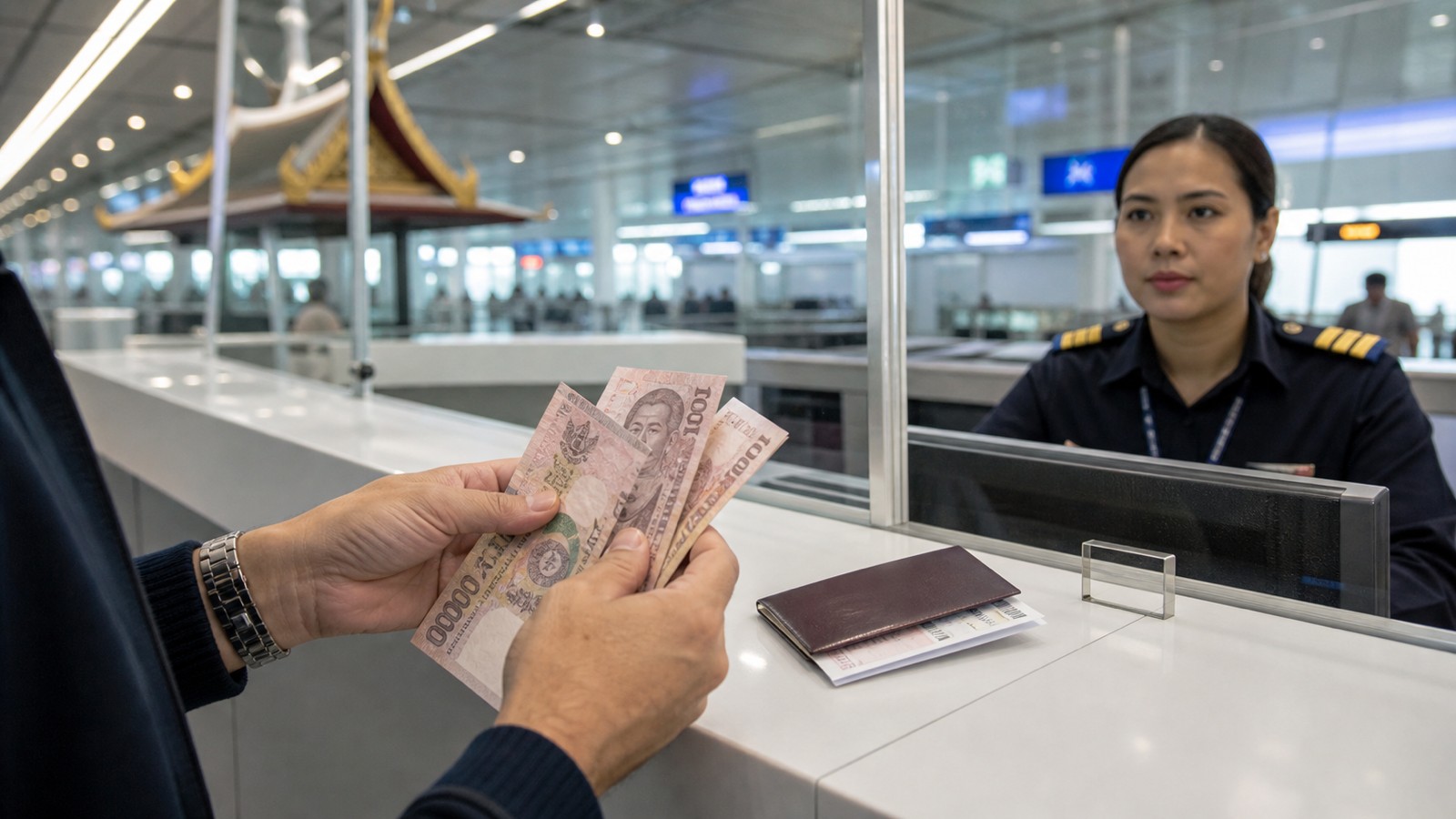
Travellers arriving in Thailand may be asked to show that they have enough money for their stay. The amount depends on the entry category, and published guidance is not identical for every visa-exempt traveller. The practical answer is to know your category, keep acceptable evidence readily available and check the latest instructions for your passport before departure.
How much money should you be prepared to show?
| Entry category | Per person | Per family |
|---|---|---|
| Tourist Visa | 20,000 baht | 40,000 baht |
| Non-Immigrant Visa | 20,000 baht | 40,000 baht |
| Visa on Arrival | 10,000 baht | 20,000 baht |
| Visa exemption | Check the rule for your passport and entry category | Check the rule for your passport and entry category |
Thailand’s Ministry of Foreign Affairs publishes a requirement of 20,000 baht per person or 40,000 baht per family for Tourist Visa holders. Official guidance for Visa on Arrival generally uses the lower threshold of 10,000 baht per person or 20,000 baht per family.
Why visa-exempt travellers see different figures
This is the part most likely to cause confusion. In its 6 July 2026 notice, the Tourism Authority of Thailand (TAT) said this is a longstanding requirement, not a new rule. TAT lists 10,000 baht per person or 20,000 baht per family for Visa on Arrival and certain transit and visa-exempt cases, and 20,000 baht per person or 40,000 baht per family for Tourist and Non-Immigrant Visas. It also says the funds check does not apply to children under 12. Some Thai embassy guidance gives the higher amount for visa-exempt travellers, so check the current instructions for your passport and place of departure. The Thai government summary notes this difference.
Do not assume that the lowest figure applies to every passport. If the guidance for your nationality is unclear, being ready to demonstrate the equivalent of 20,000 baht per person or 40,000 baht per family is the cautious approach. This is particularly relevant because Thailand has officially replaced its broad 60-day visa exemption with a 30-day visa-free stay for 60 countries from 15 September 2026. The linked report includes all four published Royal Gazette notices.
Does the proof have to be cash?
Official sources may refer to cash, traveller’s cheques, foreign currency of an equivalent value or documents demonstrating available funds. However, there is no universal official assurance that showing only a credit card, debit card or a banking-app screen will always be accepted at the checkpoint.
If an immigration officer asks for evidence, it should be genuine, current and immediately accessible. Do not place your only supporting documents in checked baggage. A recent bank statement can be useful, but the officer at the port of entry decides whether the evidence is sufficient in the circumstances.
Will everyone be asked?
No. Proof of funds is not routinely requested from every passenger. Immigration officers may ask for it as part of an entry assessment, especially where they want to confirm the purpose of travel or whether the visitor can support the proposed stay.
A visa does not guarantee admission. Travellers may also be asked for accommodation details, onward or return travel, a valid Thailand Digital Arrival Card and other documents relevant to their entry category.
Before travelling to Thailand
- Confirm whether you are entering with a visa, Visa on Arrival or visa exemption.
- Check the current instructions from the Royal Thai Embassy or Consulate responsible for your country.
- Keep proof of funds, accommodation and onward travel within easy reach.
- Check the period granted in your entry stamp before leaving the immigration counter.
For continuing updates, follow our Thailand Visa News and review our Thailand visa guides.
Connect your entry documents to the right visa
Proof of funds is only one part of a compliant stay. Start with our Thailand visa guides and compare routes such as the DTV, retirement visa and marriage visa. If Thailand is becoming your permanent home, read the separate guide to Thai permanent residence.
Sources and important note
This article is based on published guidance from Thailand’s Ministry of Foreign Affairs and Royal Thai embassies, with the original story idea drawn from The Thaiger’s proof-of-funds explainer. Information checked 17 October 2026.
Entry rules and documentary expectations can change and may differ by nationality and entry category. This general information does not replace a decision by Thai immigration.
Unsure which documents apply to your trip or longer stay? Contact Next Step Hua Hin for practical visa and immigration guidance before travelling.
For large cash-related payments, see our update on Thailand’s new THB 5 million bank cash checks, including the documents banks may request.
“Show money” at the border: what the phrase really means
Checked 30 October 2026. “Show money” is the common search term, but the legal and operational test depends on the entry route. A tourist-visa or Visa on Arrival applicant may face a stated visa-specific amount. A visa-exempt traveller can still be questioned about adequate funds and a credible trip, but there is no safe promise that one internet figure guarantees admission.
What to carry
- Accessible cash in THB or a readily convertible foreign currency if the relevant visa rule expressly calls for funds.
- A recent bank statement and working payment card as supporting evidence, not as a guaranteed substitute when an officer asks for cash.
- Onward or return travel, accommodation details and evidence that matches the purpose and length of the visit.
- For repeat visitors, proof of work, residence and commitments outside Thailand where relevant.
Admission remains an immigration decision. Screenshots can be difficult to verify, unavailable offline or inconsistent with the applicant’s name. Keep evidence current and easy to open, and never borrow money only for a staged photograph. Thailand’s official 2026 enforcement update confirms refusals can involve insufficient funds, missing itineraries and suspicious visa-run patterns. Read the government enforcement notice, our visa-exemption guide and the e-Visa application guide.
Choose Next Step Hua Hin as a preferred source
Increase the chance of seeing our Visa News in Google Top Stories.
Ask Next Step Hua Hin
Type your question below to search our website and receive an immediate answer.




One Response