
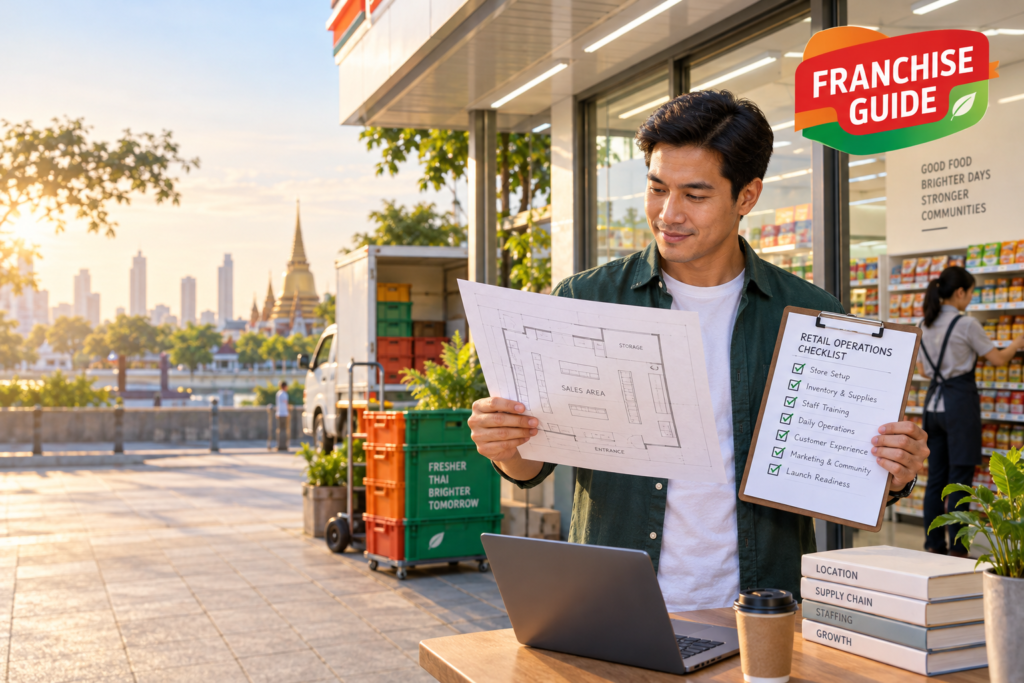
CP All describes three relevant store structures: corporate stores, Store Business Partner (SBP) stores and sub-area licence stores. At the end of 2025, the network had 15,945 Thai stores: 8,194 corporate stores (51%), 6,803 SBP stores (43%) and 948 sub-area licence stores (6%). CP All opened 700 stores in Thailand during 2025. SET CPALL year-end 2025 snapshot CPALL 2025 filing via SET/SEC
An SBP partner operates a 7-Eleven store within CP All’s modern operating system. CP All provides support covering management knowledge, product assortment, financial systems, promotions and operational advice. A partner may propose a location or take over an existing store, subject to feasibility and approval.
What the investment table must show
The live page should contain current CP All figures for each available package: entry fee, security deposit, stock, equipment, fit-out, working capital, contract term, training and profit or revenue-sharing terms. Do not use old directory figures as a current quote. Every number should show its source date and whether VAT, stock, rent, labour or refurbishment is included. The 2025 store counts above describe the network; they are not investment prices.
Staffing reality
A franchisee is not free to run the store like an independent mini-market. Recruitment, training, uniforms, work procedures and service standards sit within the CP All system and local area structure. The current agreement must be checked for the exact division of responsibility for hiring, payroll, scheduling and supervision. The owner should not assume that they can simply recruit any staff, set any procedure or change the product mix.
Questions before applying
Ask CP All who owns the premises, who pays for equipment and stock, who employs the staff, how labour costs are calculated, whether a new store can open near the branch, what happens when sales fall, and how the agreement ends. This is an operating business, not passive income.
What to understand before considering a 7-Eleven franchise
A 7-Eleven franchise in Thailand is an operating business, not a passive investment. The central system supplies the brand, product range, technology, operating standards and much of the day-to-day support, while the franchisee is responsible for running the shop well. That means the decision should be based on your ability to manage people, shifts, stock, customer service and compliance over a long period.
One point that surprises many potential operators is staffing. Franchisees do not simply recruit a private team and run the store however they like; store staff are centrally recruited and managed within the 7-Eleven system. Ask for the current rules, training expectations, working-capital requirements, fees, contract term, renewal conditions and exit arrangements before signing anything. Figures and available formats can change, so treat every online estimate as a starting point rather than an offer.
The best preparation is a written operating plan. Compare the location, trading hours, nearby competitors, storage space, delivery demand, staff coverage and likely busy periods. Also consider whether you want to work hands-on or manage through shifts. A shop can look busy and still be difficult to operate if staffing, waste, cash handling or replenishment are poorly controlled.
Related guides
- 🏍️
7Delivery and riders
See how the delivery side changes customer expectations and store operations.
Read the guide →
- 💳
TrueMoney Wallet
Understand the payment ecosystem customers may use at the counter.
Read the guide →
- 🏪
Complete Thailand guide
Return to the hub for products, services, stamps and practical tips.
Read the guide →
Ask Next Step Hua Hin
Type your question below to search our website and receive an immediate answer.