
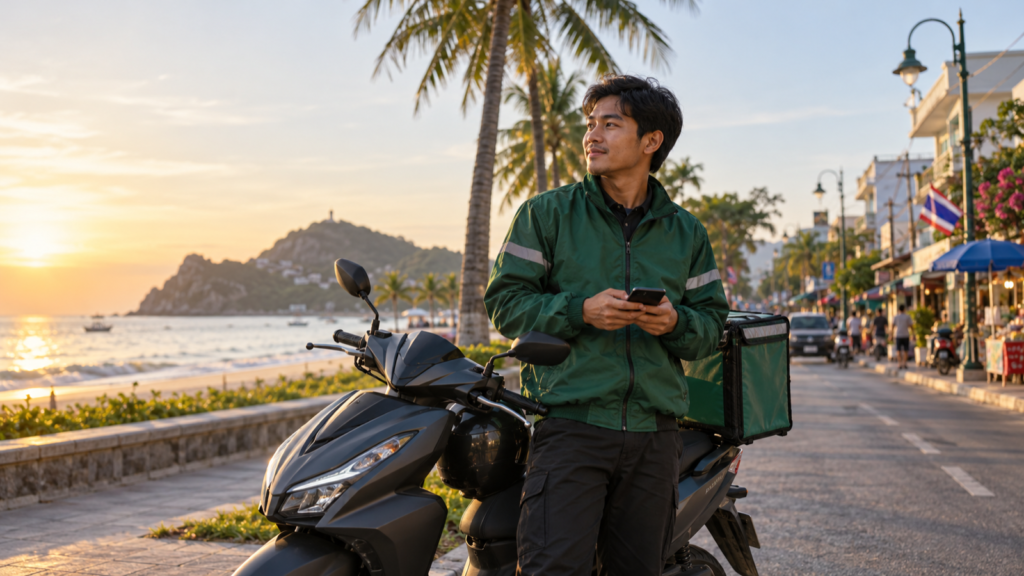
Grab is one of those apps that quietly becomes part of everyday life in Thailand. A Thai customer can order lunch, call a motorbike or car, send a forgotten key across town, buy groceries and pay without cash. A foreign resident in Hua Hin can use the same app after arriving from the airport, even when the local songthaew route is unfamiliar.
The convenience is real. So is the money trail behind it.
Every order connects three people with different costs: the restaurant, the delivery partner and the customer. Is everybody losing? The honest answer is no — but everybody is making a trade-off, and the party with the weakest room to absorb the cost can feel it most.
How Grab works in Thailand
Grab is a platform rather than a traditional taxi company or restaurant chain. Restaurants and shops list products; customers place and pay for orders; driver- and delivery-partners accept jobs; and Grab supplies the app, matching, mapping, payment, customer service, promotions and parts of the delivery network.
The same ecosystem covers GrabFood, GrabMart, GrabBike, GrabCar and GrabExpress. Grab’s Thai terms describe the people doing the work as independent driver-, delivery- or merchant-partners, not ordinary Grab employees. That distinction matters when thinking about income, expenses and risk.
Grab is popular because it compresses several jobs into one screen. For Thais, it is part of normal urban life. Foreigners use it too, especially when they want a predictable fare, an English interface, GPS tracking or a way to order from a restaurant without speaking Thai. The experience is usually easiest when the user has a Thai SIM, a payment card or GrabPay and a clearly written address. Riders also work through sudden showers, so delivery times can change quickly; check the Hua Hin weather before ordering or booking a ride.
GrabPay Wallet is different from paying by card
For the Thai GrabPay Wallet, Grab’s current terms require a citizen identification number and e-KYC. In practice, a passport alone will not normally open the stored-value wallet. Foreigners can still use Grab’s payment system by linking an accepted debit or credit card. Check Grab’s payment terms.
Check the true total
Compare the restaurant menu price with the in-app price, then add delivery, service and payment charges. Grab’s Thailand terms also say foreign payment methods can carry additional charges; travellers often see roughly 3% added for a foreign debit or credit card, so check the final checkout total. See the payment terms.
Continue the Hua Hin guide
Getting around Hua Hin, daily life and cost of living put Grab into the wider local picture.
The restaurant’s calculation: a ฿200 meal is not a ฿200 sale
Grab’s own public Thailand explanation says merchant commission varies and averages around 15–30%; an older public example uses a 30% commission. Actual agreements, campaigns, taxes, payment arrangements and promotional cost-sharing can change the result, so no article should promise that every restaurant pays exactly the same percentage.
Here is the simple mathematics behind the complaint.
Imagine a meal listed at the restaurant for ฿200.
| Illustrative calculation | Baht |
|---|---|
| Customer’s in-app food price | 200.00 |
| 30% platform commission | -60.00 |
| Approx. 3% cashless/card cost, if charged separately | -6.00 |
| Restaurant receives before food, staff, rent and packaging | 134.00 |
The card figure is an illustration. Grab has publicly said that cashless transaction costs of around 2.5–3% are among the costs covered by the platform’s share; whether a particular restaurant sees a separate deduction depends on its current agreement.
Restaurants therefore face three choices: accept a smaller margin, raise the in-app price, or stop using the platform. Many choose a higher app price. If the restaurant adds 25% to the ฿200 menu price, the customer sees ฿250. At 30% commission plus an illustrative 3% payment cost, the restaurant keeps roughly ฿167.50 before its own food and operating costs. The customer has paid ฿50 more; the restaurant still receives less than the original ฿200 direct-sale price.
That is why a “cheap” delivery promotion does not always mean a cheap meal. Check the restaurant’s own menu, the app price, the delivery fee, service charges and the final checkout total.
The rider’s calculation: gross income is not take-home pay
The delivery partner is often the most visible person in the system and the least visible part of the accounting. The rider supplies the motorbike, petrol, servicing, tyres, insurance, phone, data, time between orders and often the clothing and insulated box. A rider may also carry the risk of rain, traffic, accidents and unpaid waiting time.
Grab’s public example says that on a ฿150 food order with a ฿20 delivery fee, the restaurant might receive ฿105, Grab might retain ฿45 as a 30% commission, and the delivery partner might receive roughly ฿50–60 once the delivery fee and an incentive top-up are combined. This is an example, not a current guaranteed rate.
For a realistic way to think about earnings, suppose a rider completes 18 jobs on a good working day at an average gross payout of ฿55 per job. That is ฿990 gross for the day, or about ฿25,740 over 26 days. If petrol, maintenance, phone data, insurance and depreciation average ฿180 a day, the working income before tax and personal costs falls to about ฿21,060. A slow day, long empty journeys, weak incentives or rainy-season disruption can reduce it much further.
Some riders work part-time around another job. Others combine Grab with LINE MAN or another platform. The key point is that a headline “earnings” number is not a wage: it is a variable gross amount before the rider’s equipment and operating costs.
So who gets what?
There is no single permanent percentage split for every Grab service. For food delivery, the restaurant commission is usually calculated from the food order, while the rider’s pay is built from the delivery fee, distance, supply and demand, incentives and sometimes other adjustments. A ride-hailing driver’s calculation is different again and can vary by product, vehicle, promotions, driver status and local rules.
The broad money trail looks like this:
- The customer pays the food price, delivery fee, service charges and any tip.
- The restaurant receives the order and later receives the sale minus the agreed platform deductions.
- The rider receives a delivery or trip payout, sometimes with incentives; the customer’s delivery fee is not necessarily the rider’s full income.
- Grab uses its share for technology, mapping, customer support, payment processing, promotions, insurance-related costs, incentives and overhead — while also needing to make a profit.
That is not a simple three-way theft story. It is a convenience business whose costs are distributed across the chain. The system works when the customer values time and access more than the direct-menu price, the restaurant gains enough extra demand, and the rider’s payout covers both time and vehicle cost.
GrabUnlimited: when it is genuinely a good deal
GrabUnlimited is a subscription with vouchers and benefits that can cover eligible GrabFood and other Grab services. The exact price, voucher value, expiry rules and eligible transactions are shown in the app and can change, so check the current plan before subscribing.
The easiest test is arithmetic. If your current plan costs ฿199 and you save ฿30 in delivery or eligible vouchers on eight orders, you have already received ฿240 of visible value — before counting any ride or partner offers. If you order only once or twice a month, the subscription may be poor value. If you order lunch at work, use Grab rides and reliably use the vouchers before they expire, it can pay for itself quickly.
Read the conditions: many discounts have minimum order values, maximum savings, selected restaurants, limited redemptions or expiry dates. A discount is not a saving if it persuades you to buy food you would not otherwise have ordered.
Food delivery in Hua Hin compared with Bangkok
Bangkok has a much denser restaurant and rider network. That usually means more choice, shorter distances, more competing promotions and better coverage at most times. It also means more traffic, more congestion and greater demand surges.
Hua Hin works differently. Grab is useful across the town and surrounding areas, but the supply of restaurants and riders is thinner. Delivery distances can be longer, some outer areas have fewer options, and waiting times can stretch during rain, weekends and holiday periods. A short Bangkok order and a cross-town Hua Hin order may look similar in the app while requiring very different rider time and fuel.
In Hua Hin, compare the app total with the restaurant’s own menu when possible. For daily transport, Grab is a useful backup to a motorbike or songthaew, but using it for every short trip can cost more than renting a scooter. Grab and Bolt both operate in Hua Hin, although availability and prices change by time and location.
Rides, bikes, cars and cheap parcel delivery
GrabBike is useful for solo trips and short journeys. GrabCar is more comfortable for luggage, heat, rain, families or anyone who does not want to ride a motorbike. Fares are shown before booking, but the driver’s take-home amount is not the same as the fare shown to the passenger.
GrabExpress is the underused part of the system. You can send documents, keys, small parcels, food or other permitted items by bike, and choose a car, SUV, pickup or box truck for larger or fragile loads. Grab says the service offers live tracking, instant or scheduled delivery and vehicle options ranging from small bike parcels to bulky consignments. Check the current size, weight, prohibited-item and delivery-guarantee rules before sending anything important. Never send cash, illegal goods or documents that the service terms prohibit.
For a forgotten charger, signed paper, cake, flowers or a small shop delivery, GrabExpress can be much cheaper and faster than arranging a private courier. The app shows the price before you confirm, which makes it easy to compare with a local messenger or LINE MAN.
Grab’s competitors in Thailand
LINE MAN is Grab’s strongest everyday competitor for food, shopping, rides and messenger services, with particularly broad restaurant coverage in Thailand. Bolt competes strongly in ride-hailing in many cities and is worth checking for a car or motorbike fare. Local restaurants may also accept direct orders through LINE, Facebook or phone, often avoiding platform commission altogether.
Foodpanda is no longer a current Thailand option: its Thai service stopped taking orders on 24 May 2025. That exit left a more concentrated market, with Grab and LINE MAN the two names most residents compare for food delivery. Availability still varies by city, neighbourhood and time.
The practical verdict: are all three parties losing?
Sometimes. The restaurant can lose margin, the rider can lose money to vehicle costs and unpaid time, and the customer can pay an inflated menu price plus delivery fees. But all three can also gain something: the restaurant gains reach and orders, the rider gains flexible work and access to demand, and the customer gains time, choice and a cashless service.
The best way to use Grab is to understand the trade. Order directly when the restaurant offers a fair price and you want the business to keep more of the sale. Use Grab when convenience, distance, tracking or a promotion genuinely makes it worthwhile. Tip a rider when the weather is bad or the trip is awkward. Compare Grab and LINE MAN for rides and delivery. And treat “free delivery” as a marketing phrase until you have checked the final total.
That is the real Grab lesson in Thailand: the app is not free. It simply makes the cost trail easy to overlook.
Sources and further reading
- Grab Thailand: where merchant commission goes
- GrabUnlimited Thailand
- Grab Thailand transport, delivery and logistics terms
- GrabExpress Thailand
- LINE MAN Thailand
- Foodpanda Thailand service closure notice
- Next Step: Getting Around Hua Hin
- Next Step: Practical Life in Hua Hin
Ask Next Step Hua Hin
Type your question below to search our website and receive an immediate answer.