
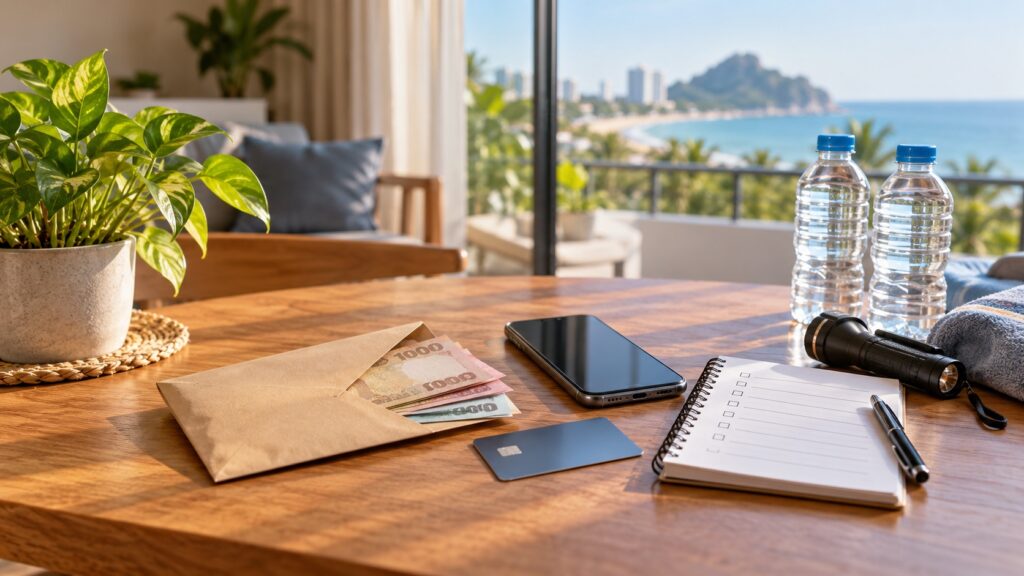
Emergency money is not just cash in a drawer. For an expat in Hua Hin, a resilient reserve has three parts: enough Thai baht for a short payment outage, money in a Thai account that can be used the same day, and further savings that can be reached within a few days without disturbing visa arrangements or selling investments in a hurry.
The right amount depends on your household, health cover, housing, transport and access to more than one bank. The goal is dependable access—not the largest possible pile of banknotes.
Practical starting point: calculate three to seven days of essential spending in cash, then separately plan for a hospital deposit, urgent travel or a major repair. Illustrative ranges such as ฿5,000–฿10,000 at home and ฿50,000–฿100,000 readily available in a Thai account can help you start the calculation, but they are not official minimums or suitable for everyone.
Build your reserve in three layers
Layer 1: physical baht for immediate disruption
This is for food, drinking water, fuel, medicines, phone credit and local transport when an ATM, card terminal, QR payment or mobile-banking service is temporarily unavailable. Base the amount on your real household spending. A couple with a car and regular prescriptions will need more than one person living near shops and transport.
Keep useful denominations, including ฿20, ฿50 and ฿100 notes. A vendor with no electronic connection may also struggle to change a ฿1,000 note. Keep your ordinary wallet separate so a lost wallet does not remove the reserve as well.
Layer 2: money available in Thailand the same day
Your immediately accessible account should cover the emergencies that are too large for household cash: an admission deposit, an insurance deductible, urgent flights, towing or repairs. Check the daily transfer and ATM limits on your own accounts before you need them. A large balance is less useful if a banking app is locked, the phone holding the SIM is lost, or the transfer limit is too low.
Where practical, keep a second route to money: another Thai account, a different card network or an overseas card that you have tested in Thailand. Save bank telephone numbers offline and understand the replacement-card process. Our guides to opening a Thai bank account and sending money to Thailand explain the everyday setup.
Layer 3: further funds available within days
The third layer can remain in savings or investments, provided you know how long access really takes. Test international-transfer instructions, beneficiary details and identity checks while everything is calm. Do not assume that an overseas balance can always be moved instantly during a bank holiday, security review or telecommunications outage.
Avoid counting the same money twice. Funds you must preserve to support an immigration application or extension should not also be treated as freely spendable emergency money. Check the conditions applying to your own visa route before withdrawing from an account used for immigration evidence.
Plan separately for hospital access
Even with health insurance, a Hua Hin hospital may need to confirm cover, obtain a guarantee of payment or collect your deductible before non-emergency treatment proceeds. Exclusions, sublimits and reimbursement-only treatment can leave you paying first. Ask your insurer which Hua Hin hospitals offer direct billing under your policy and what happens outside office hours.
If you self-insure, three to seven days of household cash is plainly not a medical fund. Decide how much can be used immediately, how the rest can be released, and who can help if you are conscious but unable to operate your phone. Do not solve this by sharing a PIN or banking password. Keep insurer, hospital and trusted-contact details with your emergency information instead. See our guides to health insurance for expats and emergency numbers and first steps.
Match the reserve to your life in Hua Hin
- Renting: allow for temporary accommodation, transport and replacing essential belongings rather than major building repairs.
- Owning a house or car: add realistic urgent repair, towing and storm-clean-up costs.
- Family household: include medicines, children’s needs and enough transport for everyone.
- Frequent travel: keep a working foreign card and enough money for an urgent ticket or hotel.
- Self-insuring: maintain a medical reserve separate from ordinary living expenses and immigration funds.
Protect the cash without making it inaccessible
- Store it discreetly, dry and above any flood-prone floor level.
- Split the reserve between two secure locations rather than one obvious hiding place.
- Keep passports, phones, cards and cash separate so one loss does not remove every option.
- Do not photograph the hiding place or discuss the amount casually.
- Replace the reserve immediately after using it and rotate damaged notes.
Hua Hin’s heavy rain can disrupt roads, electricity and individual ATMs even when the wider banking system is operating. Review the Hua Hin flood-preparedness checklist, and plan withdrawals before a known bank holiday using our guide to Thai public holidays and bank closures.
Run a six-month access test
Twice a year, count the notes and check card expiry dates, phone and SIM access, transfer limits, overseas beneficiary details, insurance contacts and the person who should be called in an emergency. Test a small transfer rather than discovering a dormant account or failed identity check during a crisis. Never store PINs, one-time passwords or full online-banking credentials in the emergency folder.
Bottom line: hold a modest amount of physical baht, a larger same-day reserve in Thailand and a tested route to additional funds. Keep medical, immigration and household needs distinct so one emergency does not create another.
If you use a digital transfer account as a backup, read our current Wise Thailand guide. Thai-address accounts have staged rollout dates, PromptPay and payment limits, and Thai ATM restrictions, so do not treat the app as your only emergency route.
Official information checked 30 October 2026: Government of Thailand payment guidance; Bank of Thailand cash-transaction FAQ; Thai Meteorological Department flood guidance.
Ask Next Step Hua Hin
Type your question below to search our website and receive an immediate answer.